

Introduction — The Hustle Myth Is a Performance Trap
For the better part of a decade, the dominant narrative in performance culture has been the same: sleep less, do more, outwork everyone. Four hours of sleep became a badge of honor. Rest became a synonym for weakness. The grind, by definition, had no off switch.
But the data has consistently told a different story. The highest performers across elite sport, executive leadership, military special operations, and scientific research share a behavior that hustle culture actively discourages: they protect their sleep with the same intensity they bring to their work.

This is not about being soft. It is about understanding the biology. Sleep is not downtime — it is when your brain and body execute the upgrades that your effort during the day made possible. At Grindset Labs, we have built our entire product philosophy around this distinction. Recovery is not the rest from performance. It is part of the performance equation.
What the Research Actually Says About Sleep and Performance
The evidence is not subtle. Sleep deprivation is one of the most well-studied performance impairments in human biology, and the results consistently show that even moderate sleep restriction — six hours per night — produces deficits equivalent to full 24-hour sleep deprivation.
A landmark study from the University of Pennsylvania demonstrated that subjects who slept six hours per night for two weeks showed the same level of cognitive impairment as subjects who were kept awake for 24 hours straight. Critically, the six-hour group did not perceive themselves as impaired — they had adapted to their diminished capacity. The performance loss was real. The awareness of it was not.
This is the insidious cost of chronic under-sleep: it narrows your perception of what you are capable of while simultaneously reducing your ability to close that gap. You are running at 70 percent and calling it 100.
Understanding the science of deep sleep is where the performance case for sleep starts — because it is in deep sleep where the most critical physical and neurological restoration actually happens.
How Sleep Deprivation Undermines the Very Things Hustle Culture Values
Hustle culture places premium value on a specific set of traits: focus, decisiveness, creativity, resilience, and output. The irony is that chronic sleep deprivation degrades every single one of these qualities at a measurable, documented level.
Focus and Sustained Attention
Sustained attention — the ability to stay locked on a task for an extended period — degrades rapidly with sleep loss. Even minor sleep restriction reduces the number of hours you can maintain high-quality focus before cognitive drift sets in. The long work sessions that hustle culture idolizes become increasingly counterproductive as sleep debt accumulates.
Decision Quality
Sleep-deprived individuals demonstrate impaired risk assessment, reduced impulse control, and a tendency toward short-term thinking at the expense of strategic reasoning. In high-stakes environments — business decisions, competitive scenarios, complex problem-solving — this is a catastrophic liability disguised as dedication.
Creativity and Problem-Solving
REM sleep specifically supports divergent thinking, insight, and novel connection-making. Sleep-deprived brains trend toward rigid, habitual thinking patterns. The creative breakthroughs, innovative solutions, and flexible thinking that high performers depend on require adequate sleep — not less of it.
Emotional Regulation
The amygdala — the brain's threat-detection center — becomes 60 percent more reactive to negative stimuli under sleep deprivation. This produces heightened emotional volatility, reduced empathy, and impaired interpersonal judgment. In any environment where relationships, leadership, and communication matter, this is a direct performance liability.
Physical Output and Recovery
Training adaptations require sleep to execute. The hormonal environment — specifically growth hormone release and testosterone maintenance — is concentrated in slow-wave sleep. Athletes who consistently sleep under seven hours show measurably slower recovery, higher injury rates, and diminished performance on tests of speed, strength, and reaction time.

The Sleep Habits of Elite Performers
Look at the people at the top of competitive fields, not the cultural mythology around them, and a consistent pattern emerges.
Roger Federer famously slept 10 to 12 hours per night during peak competitive periods. LeBron James has publicly discussed prioritizing eight to ten hours and strategic napping as central to his career longevity. Usain Bolt, the most successful sprinter in history, was known for extensive sleep and deliberate rest between training sessions. Stanford sleep researcher Cheri Mah found that basketball players who extended their sleep to 10 hours per night showed significant improvements in sprint times, free throw accuracy, and reaction speed.
In the business world, Amazon founder Jeff Bezos has discussed prioritizing eight hours of sleep as a deliberate leadership decision — arguing that sleep-deprived decisions compound negatively over time. Microsoft co-founder Bill Gates has made similar observations about the relationship between sleep and his productive output.
The throughline is consistent: the people operating at the highest levels have come to understand that sleep is not in conflict with performance. It is the substrate on which performance is built.
Sleep as a Daily Lifestyle Choice, Not a Luxury
One of the most damaging aspects of hustle culture's sleep narrative is the framing of rest as something you earn — a reward for sufficient output, rather than a non-negotiable input to daily function. This framing reverses the biological reality.
Sleep is not something you deserve after a productive week. It is a daily maintenance system that makes productivity possible. Treating it as a lifestyle choice — something you actively structure your day around — rather than whatever time is left after everything else, is the fundamental shift that separates consistent high performers from people who burn out in cycles.
This means making deliberate decisions during daylight hours that protect your sleep window. Caffeine timing. Training schedule. Evening light exposure. Meal timing. Wind-down habits. These are not sleep habits — they are daily lifestyle choices that either support or undermine the quality of recovery you access each night.
Managing daily habits around how to fall asleep faster without feeling groggy is one of the most practical places to start — because falling asleep efficiently is the first condition of accessing quality recovery.
The Cognitive Edge That Sleep Gives You
Cognitive performance is where the sleep advantage is most consistently undervalued. People accept physical recovery benefits intuitively — your muscles need time to repair. But the cognitive benefits of adequate sleep are equally powerful and equally biological.
Working Memory and Executive Function
Working memory — the system that holds and manipulates information in real time — is acutely sensitive to sleep quality. Sleep-deprived individuals show degraded working memory capacity, which impairs complex reasoning, task management, and the ability to hold multiple variables in mind simultaneously. These are not minor edge cases — they are central to high-output cognitive work.
Learning and Skill Acquisition
Sleep is required for skill consolidation. Whether you are learning a physical movement pattern, a new language, a technical skill, or a strategic framework, the encoding of that learning into long-term memory happens primarily during sleep — particularly during slow-wave and REM stages. Cutting sleep short cuts the learning cycle short.
Mental Clarity and Processing Speed
The cognitive fog that follows a poor night is not subjective — it reflects genuinely slower neural processing. Reaction times increase, information processing slows, and the quality of output degrades even when effort remains high. Hours worked under sleep deprivation produce measurably less than equivalent hours worked well-rested.
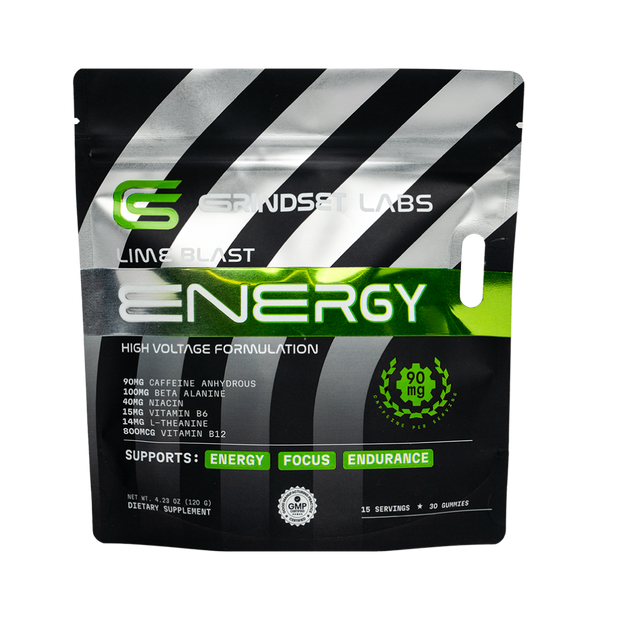
The Grindset Labs Energy Gummies are designed to support clean morning activation — not to replace sleep, but to complement a recovery system that starts the night before.
Physical Output, Recovery, and the Sleep Equation
For anyone who trains — whether for competitive performance, body composition, or general health — the relationship between sleep and physical output is direct and significant.
Hormonal Output
Growth hormone and testosterone — the two primary anabolic hormones driving muscle repair, body composition, and physical capacity — are both critically dependent on sleep quality. Growth hormone is secreted primarily during slow-wave sleep. Testosterone is produced and regulated overnight. Consistent sleep restriction is one of the fastest ways to degrade the hormonal environment that training is trying to build.
Injury Risk and Tissue Repair
Research from the American Academy of Pediatrics found that adolescent athletes who slept fewer than eight hours per night were 1.7 times more likely to sustain an injury than those who slept eight or more hours. The same mechanism applies across age groups: sleep-deprived tissue repairs more slowly, proprioception degrades, and reaction time decreases — all of which elevate injury risk.
Performance Metrics
Across strength, speed, power, and endurance metrics, sleep restriction consistently degrades output. A single night of partial sleep deprivation can reduce grip strength, reduce VO2 max performance, and impair time-to-exhaustion on high-intensity efforts. These are not marginal effects — they are meaningful performance gaps that compound across a week, a training block, or a career.
What Hustle Culture Gets Wrong About Rest
The core error of hustle culture's relationship with sleep is a confusion between effort and output. Spending more hours working is not the same as producing more value. Sleeping less to work more does not scale. It creates a compounding debt that progressively degrades the quality of every hour spent working.
The productive hours of a well-rested person are worth more than the extended hours of a sleep-deprived one — not marginally, but significantly. Studies on workplace performance show that cognitive errors, interpersonal conflicts, reduced creativity, and poor decision-making attributable to sleep loss cost the United States economy hundreds of billions of dollars annually.
The highest performers are not just more talented or more motivated. They are also better recovered. They understand that the quality of their output in the next 16 hours is determined in large part by the quality of the 8 hours that precede them.
Building a High-Performance Sleep Identity
Changing your relationship with sleep requires more than adding blackout curtains or trying a new supplement. It requires shifting how you think about sleep — from a passive default to an active performance input.
This means treating your sleep window with the same protection you give your training block or your most important work sessions. It means building consistent daily habits — caffeine timing, light management, wind-down routines — that signal to your biology that recovery is a priority. And it means measuring the outcome: not just duration, but how you wake up, how long it takes you to feel sharp, and how your energy holds across the day.
A practical starting framework for integrating sleep as a daily performance practice:
• Set a consistent bedtime and wake time, including weekends. Circadian consistency is the foundation of sleep quality.
• Treat caffeine cutoff as a hard rule, not a guideline. Move it earlier than feels necessary — your slow-wave sleep will thank you.
• Design your evening as a wind-down system. Dim lights, step away from screens, reduce stimulus input, and execute a brief pre-sleep routine with intention.
• Prioritize your first 3 hours of sleep above all else. This is where your deep sleep is concentrated and where your hormonal and physical recovery output is highest.
• Track how you feel, not just how long you slept. Waking up sharp and sustaining energy without a crash is a more meaningful recovery metric than hours in bed.
The Role of Supplements in a Performance Sleep Stack
High-output performers often have elevated physiological demands on their recovery system — higher training loads, higher stress exposure, and higher cortisol output than the average population. Targeted supplementation can help bridge the gap between demanding daily output and the biological conditions needed for quality sleep.
The most evidence-supported compounds for a performance sleep stack include:
Magnesium
Magnesium glycinate and magnesium threonate both support GABA receptor activation — the primary inhibitory signaling pathway that allows the nervous system to down-regulate for sleep. Magnesium deficiency, which is extremely common in active populations, directly impairs this process and is associated with poor sleep quality, elevated resting cortisol, and muscle cramping.
Ashwagandha
Ashwagandha is one of the most clinically validated adaptogens for stress and cortisol management. For high-output individuals carrying significant daily stress load, evening ashwagandha supplementation has been shown to reduce cortisol, improve time to sleep onset, and improve subjective sleep quality and morning alertness.
L-Theanine
L-Theanine promotes alpha brain wave activity — the calm, focused state associated with the period just before sleep — without inducing sedation. It is particularly useful for individuals who experience racing thoughts or anxiety-driven sleep disruption. Waking up clear rather than foggy is one of the primary differentiators of L-Theanine from sedative sleep compounds.
Build your nighttime recovery system with formulas designed for performance. Start with the Grindset Labs 7-Day Restore Trial Pack to experience structured recovery as part of a complete performance routine.

Conclusion — Sleep Is the Competitive Advantage Most People Ignore
Hustle culture will continue to celebrate sleep deprivation as long as the relationship between effort and output is misunderstood. But the data does not support the mythology. The highest performers are not sleeping less — they are sleeping better, protecting their recovery with intention, and operating from a biological baseline that short-sleepers cannot access.
Prioritizing sleep is not a concession to weakness. It is a strategic decision based on a clear-eyed understanding of how performance is built. Every hour of quality sleep compounds into sharper thinking, faster recovery, better decision-making, and higher output across every domain you care about.
At Grindset Labs, we build products and content around the full performance cycle — including the hours when your body does its most important work. Sleep is not separate from your performance stack. It is the foundation it runs on.
Work hard. Recover harder. Let the consistency compound.
FAQs
How many hours of sleep do high performers actually need?
The research consistently points to seven to nine hours for most adults, with elite athletes often targeting nine to ten during high-volume training periods. There is substantial individual variation, but the six-hours-is-enough narrative is not supported by population-level data. The rare individual who genuinely thrives on six hours represents a genetic outlier, not a replicable performance strategy.
Is napping a valid substitute for nighttime sleep?
Strategic napping — particularly a 20-minute nap in the early afternoon — can meaningfully restore alertness and short-term cognitive performance. However, naps do not replicate the slow-wave sleep architecture of a full night. They are a useful supplement to a solid nighttime foundation, not a replacement for it.
Can you train yourself to need less sleep?
No. Research does not support the idea that sleep need can be permanently reduced through adaptation. What people experience as adaptation to short sleep is actually adaptation to their own impairment — they stop noticing the deficits while continuing to experience them. Objective performance measures consistently show degradation in sleep-restricted individuals over time.
How does stress from a demanding lifestyle affect sleep quality?
Psychological and physical stress elevates cortisol, which is directly antagonistic to the hormonal environment required for deep sleep. High-output lifestyles that do not include intentional stress management practices — through wind-down routines, mindfulness, physical exercise, and targeted supplementation — tend to produce chronically elevated cortisol that degrades sleep quality even when sleep duration appears adequate.
What is the first change a sleep-deprived person should make?
Consistency of sleep timing is the highest-leverage single change available. Setting a consistent wake time — and protecting it regardless of when you went to bed the night before — anchors your circadian rhythm and progressively improves the biological conditions for faster sleep onset, deeper sleep, and more refreshed mornings. It costs nothing and typically produces noticeable results within one to two weeks.