

Introduction — Your Body Keeps Score
High output demands high input. Most people understand this when it comes to training and nutrition. But recovery — the third side of the performance triangle — gets treated as an afterthought until the body starts sending louder and louder signals that something is wrong.
The problem is that those signals are easy to dismiss. Feeling tired feels like not trying hard enough. Aching joints feel like the cost of training seriously. Mood swings feel like stress, not physiology. But these are not character flaws. They are physiological feedback — your body telling you that the recovery investment is not matching the output demand.
This guide is about learning to read those signals clearly, before they escalate from inconveniences into injuries, illness, or burnout.

What Recovery Actually Means
Recovery is not simply the absence of training. It is an active biological process involving hormonal regulation, tissue repair, nervous system restoration, and cellular energy replenishment. Every time you train hard, work a long shift, or deal with high cognitive load, you create a stress response in the body. Recovery is the period during which that stress response resolves and the body adapts.
This process happens across multiple timeframes. Acute recovery happens in the hours immediately after a training session. Short-term recovery unfolds over 24 to 72 hours as muscles rebuild and hormonal systems rebalance. Long-term recovery is the cumulative result of weeks and months of consistent rest, nutrition, and sleep — and it is the foundation of actual performance improvement over time.
When any of these windows are consistently compromised, the signs accumulate. What follows are the most reliable indicators to watch for.
Recovery is also about what you put into your body post-training. See how Grindset Labs Restore Gummies are built to support the acute recovery window with transparent, tested ingredients.
Physical Signs Your Recovery Is Falling Short
Persistent Muscle Soreness
Delayed onset muscle soreness — DOMS — that lasts beyond 72 hours after a session is a sign that your recovery processes are not keeping pace with training load. Normal soreness peaks around 24 to 48 hours and resolves by day three. When soreness lingers into day four, five, or beyond, it indicates that protein synthesis and inflammation resolution are both lagging — likely due to insufficient sleep, inadequate protein intake, or chronic training overload without enough recovery time.
Elevated Resting Heart Rate
Your resting heart rate is one of the most reliable physiological markers of recovery status. An increase of five to seven beats per minute above your normal baseline — measured first thing in the morning before getting out of bed — is a consistent indicator of incomplete recovery, elevated systemic stress, or oncoming illness. Many performance athletes track this daily as an early warning system.
Joint Pain and Stiffness
While muscle soreness is expected after training, joint pain is a different signal entirely. Persistent aching in the knees, shoulders, hips, or lower back that does not resolve with normal rest suggests chronic inflammation — a common result of training volume that exceeds recovery capacity. Ignoring joint pain is one of the most reliable paths to a serious overuse injury.

Frequent Illness
The immune system and recovery systems compete for the same biological resources. When recovery demand consistently outpaces supply, immune function is one of the first things to decline. If you are getting sick more often than usual — picking up every cold that passes through your environment, taking longer to recover from minor illness — it is a direct sign that your body's resources are stretched too thin.
Unexplained Weight Changes
Rapid weight fluctuations — particularly unintentional weight loss despite adequate caloric intake — can indicate chronically elevated cortisol driving muscle catabolism. Conversely, unexpected weight gain in the context of high training volume often reflects water retention from systemic inflammation.
Mental and Emotional Warning Signals
Recovery is not purely physical. The brain and nervous system require just as much restoration as your muscles, and they signal their deficits in ways that are easy to misattribute.
Motivation Collapse
When training stops feeling rewarding and starts feeling like a burden you resent, it is rarely a willpower issue. Loss of motivation toward activities you normally enjoy — especially training and competition — is a defining symptom of overreaching and the early stages of overtraining syndrome. The neurological reward pathways that make effort feel meaningful become blunted under chronic stress without sufficient recovery.
Irritability and Mood Instability
Elevated cortisol and suppressed testosterone are both common consequences of inadequate recovery. Both hormones have significant effects on mood regulation. When recovery is poor, this hormonal imbalance shows up as irritability, short fuse, emotional volatility, and difficulty managing normal stressors. Recognizing this as a physiological signal rather than a personality problem is the first step.
Difficulty Concentrating
Cognitive performance is highly sensitive to recovery status. Working memory, decision speed, reaction time, and sustained attention all degrade significantly under conditions of poor sleep and accumulated physical stress. If your mental sharpness is declining at work or school, it may not be a focus problem — it may be a recovery problem.
Mental performance and physical recovery are closely linked through the same energy systems. Learn how Gummies support both cognitive function and physical output as part of a daily recovery-forward routine.

Performance Metrics That Don't Lie
In the gym or sport, the numbers often reveal recovery status before subjective feeling does. These are the key performance indicators to track:
- Strength plateau or regression: Inability to progress on lifts you have been consistently improving, or notable drops in maximal strength output, indicate that adaptation has stalled — almost always because recovery is insufficient for the training stimulus.
- Reduced endurance capacity: If your cardio or sport-specific conditioning feels significantly harder at the same effort level, your aerobic system is likely under-recovered. This shows up as elevated heart rate at submaximal intensities and faster-than-expected fatigue onset.
- Slower skill acquisition: Learning and consolidating new movement patterns or technical skills requires quality sleep and recovery. If skill development has plateaued despite consistent practice, the recovery investment may need to increase.
- Longer warm-up requirements: Needing more time and effort to feel ready to perform at the start of a session is a common early indicator of accumulated fatigue that has not been adequately resolved.
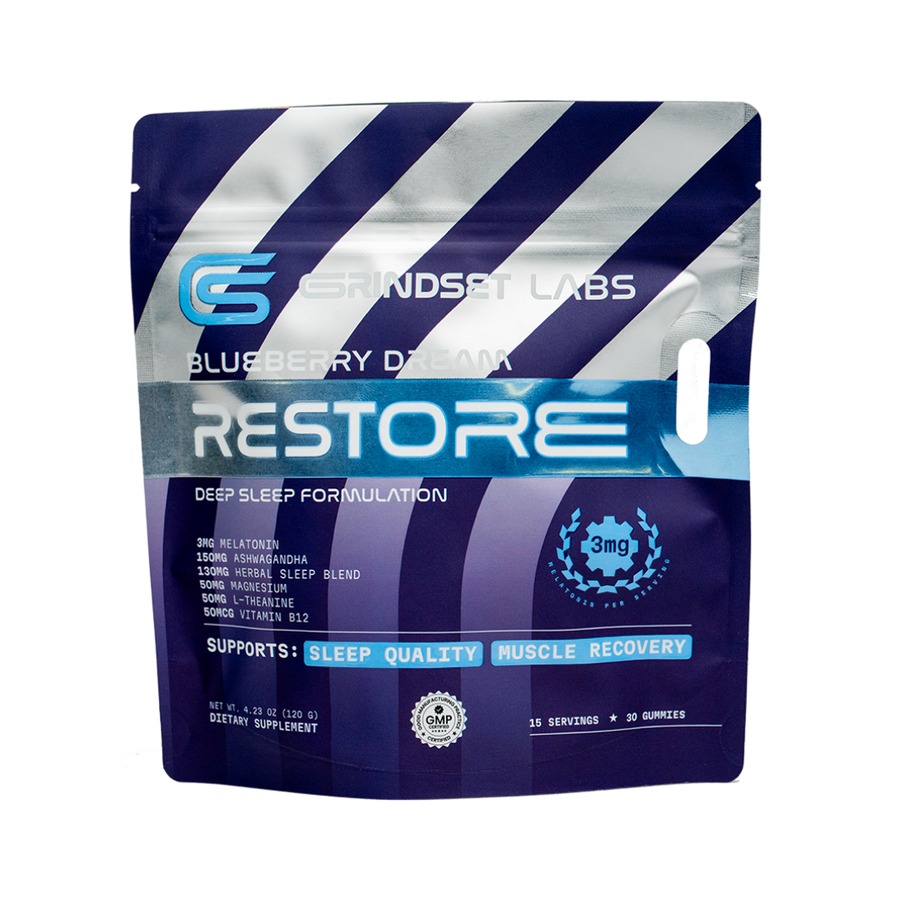
Sleep Quality as a Recovery Indicator
Sleep is both a recovery tool and a recovery indicator. When recovery is poor, sleep quality often degrades alongside it — creating a feedback loop that compounds both problems.
Signs that your sleep quality has dropped include: difficulty falling asleep despite feeling tired, waking multiple times during the night, vivid or stressful dreams, waking unrefreshed regardless of total sleep hours, and heavy reliance on caffeine to maintain function through the day.
Chronically elevated cortisol from under-recovery is one of the primary drivers of poor sleep quality in high-output individuals. It disrupts melatonin production and keeps the nervous system in a state of alert that is incompatible with deep, restorative sleep.
Structured nighttime recovery can help break this cycle. The Grindset Labs 7-Day Restore Trial Pack is a straightforward way to experience the impact of targeted recovery support within a week.
What Happens When You Ignore the Signals
The body escalates its signals when they are consistently ignored. What begins as fatigue and motivation loss progresses through a predictable sequence if recovery debt continues to accumulate:
- Functional overreaching: Short-term performance decrements that resolve with a brief recovery period of days to a week.
- Non-functional overreaching: More severe performance decline requiring weeks of recovery, accompanied by hormonal disruption, mood changes, and immune suppression.
- Overtraining syndrome: A serious clinical condition characterized by prolonged performance decline, endocrine system disruption, chronic fatigue, and psychological symptoms. Full recovery can take months.
The distance between functional overreaching and non-functional overreaching is often just a few ignored warning signals. The earlier you respond to what your body is communicating, the less significant the intervention needs to be.
How to Improve Recovery Starting Tonight
Recovery improvements do not need to be complex to be effective. The highest-leverage adjustments follow a simple hierarchy:
- Prioritize sleep above all else. Seven to nine hours per night, consistent timing. This single variable has more influence over recovery quality than any supplement or therapy.
- Increase protein intake. If your recovery is lagging, assess whether your protein consumption matches your training volume. Most active individuals benefit from 0.7 to 1 gram of protein per pound of body weight daily.
- Manage training volume intelligently. Recovery ability has a ceiling. When training volume consistently exceeds that ceiling without adjustment, accumulation happens. Planned deload weeks every four to six weeks are not weakness — they are programming.
- Address nutrition timing. Post-training nutrition within 30 to 60 minutes of a session meaningfully accelerates acute recovery. Pre-sleep protein consumption supports overnight muscle protein synthesis.
- Reduce non-training stressors where possible. Psychological and occupational stress drives the same cortisol response as physical training. Total stress load — not just gym volume — determines recovery demand.
For high-output individuals managing significant training loads, daily supplement support fills meaningful gaps. Explore the Grindset Labs full product range to build a stack that matches your recovery demands.
Conclusion — Recovery Is Not Optional
The signals your body sends are not obstacles to your performance goals. They are data. Persistent soreness, declining motivation, mood instability, poor sleep, dropping performance numbers — these are not signs that you need to push harder. They are signs that your recovery investment needs to match your output.
At Grindset Labs, every formula is built around the understanding that performance is a cycle. Training creates the stimulus. Nutrition provides the substrate. Recovery — through sleep, rest, and targeted support — converts that stimulus into actual adaptation. Shortchange any part of the cycle and the whole thing slows down.
Read the signals. Respond before they escalate. And build a recovery practice as intentional as your training.
Start your recovery upgrade today. Visit the Grindset Labs Learn page for more performance and recovery resources built around the same science-backed philosophy.
FAQs
How do I know if I am overtraining or just fatigued?
Normal fatigue resolves within 24 to 72 hours of rest. Overreaching fatigue persists beyond 72 hours and is accompanied by performance decrements, mood changes, and sleep disruption. If pulling back training volume and increasing sleep for one full week does not produce noticeable recovery, that is a meaningful signal that more significant intervention is needed.
Can poor nutrition mimic overtraining symptoms?
Yes. Caloric deficit, inadequate protein, and micronutrient deficiencies — particularly in iron, magnesium, and vitamin D — all produce symptoms that overlap closely with overreaching: fatigue, poor recovery, mood instability, and declining performance. Before assuming overtraining, assess whether nutritional inputs match output demands.
How long does it take to recover from overtraining syndrome?
Full recovery from clinically diagnosed overtraining syndrome can take anywhere from two months to a year depending on severity. This is why early recognition and response to warning signals is so critical — the earlier the intervention, the shorter and less disruptive the recovery.
Does active recovery help or should I rest completely?
Light active recovery — walking, swimming, gentle mobility work — promotes blood flow and reduces muscle soreness without adding training stress. It is generally preferable to complete inactivity for short-term recovery. Complete rest is most appropriate when injury, illness, or severe accumulated fatigue is present.
Is it normal to lose motivation for training occasionally?
Brief motivational dips are normal and do not automatically indicate overreaching. Persistent motivation loss — lasting more than two weeks and accompanied by performance decline, mood changes, or disrupted sleep — is a more significant signal worth taking seriously.