

Introduction — The Case Against More Caffeine
There is a point in most high-performers' relationship with caffeine where more stops working. The alertness blunts, the anxiety climbs, the sleep suffers, and the withdrawal symptoms begin appearing on days when the dose is missed. At that point, adding more caffeine is not solving the energy problem — it is deepening the dependency that created it.
Non-stimulant energy supplements occupy a different part of the energy equation entirely. Rather than forcing your nervous system into a state of artificial alertness, they support the biological mechanisms that produce genuine energy: ATP generation, mitochondrial efficiency, cortisol regulation, and cellular repair. The results are not immediate in the way caffeine is — but they are also not followed by a crash, a tolerance ceiling, or a disrupted sleep architecture.

This guide covers the non-stimulant compounds with the strongest evidence base and the most practical role in a daily lifestyle built around consistent performance.
How Non-Stimulant Energy Supplements Work Differently
Stimulants create the sensation of energy primarily by blocking adenosine receptors and triggering catecholamine release — your brain's stress response chemicals. This produces subjective alertness but does not increase actual cellular energy production. It borrows from your future recovery to pay for your present alertness.
Non-stimulant energy compounds work upstream. They support ATP synthesis directly, reduce the cellular cost of stress responses, replenish cofactors that energy metabolism depends on, and improve the efficiency of recovery — so you start each day with a fuller biological battery rather than one that is chronically depleted. The effect is less dramatic in the moment but more robust over weeks and months of consistent use.
This distinction matters especially for people managing demanding schedules who have noticed that their caffeine baseline keeps rising without a corresponding improvement in how they actually feel. If that pattern sounds familiar, the Grindset Labs Learn page offers additional context on the biology of performance and how the full recovery cycle shapes your daily output.
Magnesium: The Deficiency Most Fatigue Traces Back To
Magnesium deficiency is one of the most common and most overlooked contributors to chronic fatigue. Research estimates that a significant proportion of the population — and a higher proportion of active individuals who lose magnesium through sweat — do not meet their daily magnesium requirements through diet alone.
Magnesium is involved in over three hundred enzymatic processes, including the production of ATP itself. Without adequate magnesium, mitochondrial energy production is impaired at the cellular level. This manifests as persistent fatigue, reduced exercise capacity, poor sleep quality, elevated resting cortisol, and impaired recovery — all symptoms that are commonly addressed with more caffeine, which does not solve the underlying deficiency.
Magnesium glycinate is the most bioavailable and best-tolerated form for most people. It crosses the blood-brain barrier efficiently and supports both the neurological calm required for quality sleep and the cellular energy production that drives daytime output. Taking it in the evening supports both functions simultaneously.

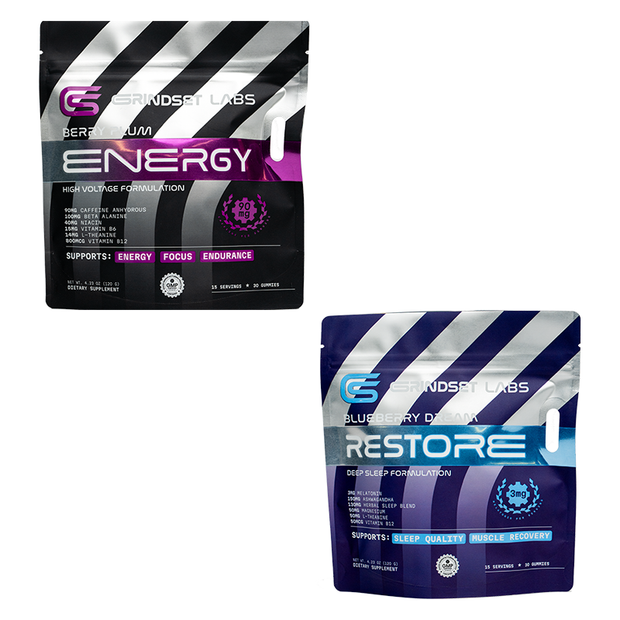
If your recovery quality feels poor even when sleep duration is adequate — waking up tired, struggling with afternoon energy, or experiencing frequent muscle soreness — magnesium deficiency is worth investigating. The Grindset Labs Restore Gummies include compounds that support this recovery window, making them a practical addition to an evening supplement routine.
CoQ10 and Mitochondrial Support
Coenzyme Q10 (CoQ10) is a compound produced naturally in the body that plays a central role in the mitochondrial electron transport chain — the process by which cells convert nutrients into ATP. As CoQ10 levels decline with age (a process that accelerates after 30) or are depleted by statin medications, cellular energy production efficiency drops.
Supplemental CoQ10 supports mitochondrial function and has been shown to reduce fatigue in individuals with lower baseline levels, improve exercise capacity, and support cardiovascular function. The ubiquinol form has superior absorption compared to ubiquinone, particularly in older adults or individuals with absorption challenges.
CoQ10 is not a fast-acting compound. Its benefits accumulate over weeks of consistent supplementation and are most pronounced in individuals with depleted baseline levels. For younger adults with no metabolic conditions, the effect is typically subtler — more of an efficiency optimization than a dramatic fatigue reduction.
Adaptogens for Stress-Related Fatigue
A meaningful proportion of chronic fatigue — especially in high-output individuals — is driven not by inadequate energy production but by the excessive energy cost of chronic stress. The hypothalamic-pituitary-adrenal axis — your body's stress response system — is metabolically expensive to run continuously. Chronic psychological and physical stress keeps cortisol elevated, which depletes energy resources, disrupts sleep, and ultimately reduces the output it is supposed to support.
Adaptogens modulate this stress response by supporting adrenal function and reducing the amplitude of cortisol spikes. The result is that the same stressors cost your body less energy, leaving more available for performance.
Ashwagandha is the most thoroughly researched adaptogen for cortisol reduction and fatigue. Multiple controlled trials show it reduces perceived stress, lowers cortisol levels, improves sleep onset, and — notably — supports testosterone levels in men who are experiencing stress-related suppression. Rhodiola rosea is particularly useful for mental endurance: it reduces perceived effort during cognitively demanding tasks and supports focus under fatigue.
Adaptogens are best understood as lifestyle compounds — they work best when taken consistently and in the context of other healthy habits, not as a standalone rescue from a depleted system. If stress-related fatigue is a consistent pattern, pairing adaptogens with improved recovery practices — including the Grindset Labs Restore Gummies and the sleep hygiene practices outlined in our recovery content — produces better outcomes than either approach alone.
B Vitamins: When They Help and When They Don't
B vitamins — particularly B12, B6, B2, and folate — are essential cofactors in energy metabolism. Without adequate B vitamins, the biochemical pathways that convert food into ATP cannot function efficiently. Deficiency in these vitamins produces fatigue, cognitive fog, mood disruption, and reduced physical capacity.
The important nuance: B vitamin supplementation helps if you are deficient. If your B vitamin status is adequate, supplementing additional amounts does not produce more energy — your body excretes the excess. This is why the megadose B vitamin formulas in most energy drinks are largely irrelevant for most people who eat a reasonably varied diet.
The populations most likely to benefit from B vitamin supplementation include strict vegans and vegetarians (B12 is almost exclusively found in animal products), older adults with reduced B12 absorption, individuals on metformin (which reduces B12 absorption), and people with certain genetic variants affecting B vitamin metabolism. For everyone else, whole food sources of B vitamins — eggs, leafy greens, legumes, meat — are more effective than supplements.
Electrolytes and the Hydration Energy Connection
The relationship between hydration status and energy is direct and frequently underestimated. A body water deficit of just one to two percent of body weight produces measurable declines in cognitive performance, mood, and physical capacity. Two to three percent produces performance decrements equivalent to mild sleep deprivation. Most people operating at this level of dehydration attribute the symptoms to needing more caffeine rather than more water.
Electrolytes — primarily sodium, potassium, and magnesium — determine how well your body retains and uses the water you consume. Plain water without adequate electrolytes does not rehydrate as effectively as electrolyte-balanced fluid, particularly after exercise or in hot environments. This is why dedicated electrolyte supplementation can produce noticeable energy and performance improvements even in people who consider themselves well-hydrated.
Building electrolyte intake into your daily routine — not just on training days — is one of the simplest, lowest-cost non-stimulant energy upgrades available. Pair this with consistent supplementation using the Grindset Labs and you have a non-stimulant foundation that supports both physical and cognitive output throughout the day.
Who Benefits Most from a Non-Stimulant Approach
Non-stimulant energy supplements are particularly valuable for several populations: individuals with caffeine sensitivity or anxiety disorders where stimulants worsen symptoms, people who have already maximized their caffeine intake and are experiencing diminishing returns, those who train or work in the afternoon and evening when stimulants would disrupt sleep, and anyone who has noticed that their energy is chronically low in a way that caffeine no longer fully addresses.
They are also the right choice for anyone building a long-term performance system rather than chasing short-term daily output. Non-stimulant compounds build capacity over time. Stimulants borrow against it. A stack that leans heavily on stimulants has a ceiling that non-stimulant support does not.
For context on how these compounds interact with the recovery side of the performance cycle — and why recovery support is as important as energy support — the Grindset Labs article on why recovery fails even when you think you're doing it right is a useful companion read.
Building a Non-Stimulant Daily Energy Routine
The strongest non-stimulant energy routine starts with the foundations: sleep, hydration, adequate dietary protein, and consistent movement. These are not supplements — they are the substrate that supplements act on. Without them, the best non-stimulant stack still runs on a depleted system.
On top of that foundation, a practical daily non-stimulant stack might include: monohydrate in the morning with food, magnesium glycinate in the evening before bed, an electrolyte supplement or mineral-rich water through the day, and ashwagandha in the evening for cortisol management and sleep support.
This stack works through different mechanisms, does not produce tolerance, does not disrupt sleep, and compounds in effectiveness over weeks of consistent use. It is not dramatic in the way a pre-workout is — but the results it produces are durable in a way that stimulant-dependent energy management is not.
If you want to experience a structured approach to non-stimulant performance support, the Grindset Labs 7-Day Restore Trial Pack gives you a week-long window to see what recovery-focused supplementation actually adds to your daily energy baseline.
Conclusion — Sustainable Energy Doesn't Need a Stimulant
The most common energy strategy — more caffeine, repeated — has a ceiling. Non-stimulant energy supplements do not. They support the cellular, hormonal, and neurological systems that produce energy from the inside out, and their benefits accumulate rather than plateau.
The shift to a non-stimulant energy approach requires patience — these compounds do not deliver the immediate hit of a caffeinated product. But the energy they support is real, repeatable, and not borrowed from your future recovery. For anyone building a lifestyle around consistent, long-term performance rather than short-term output spikes, that is a more valuable proposition than any energy drink.
FAQs
Can non-stimulant energy supplements replace caffeine entirely?
They can for many people, particularly those whose fatigue is rooted in deficiency, poor recovery, or chronic stress rather than genuine low energy capacity. For others, the best approach is reducing caffeine dependence while building non-stimulant support — using caffeine more strategically rather than eliminating it.
How long before non-stimulant supplements improve my energy?
Electrolytes and hydration-related improvements can be felt within days. typically shows effects within two to four weeks of consistent use. Magnesium and adaptogens generally require two to four weeks to produce noticeable changes in sleep quality, stress resilience, and sustained energy.
What is the best non-stimulant supplement for afternoon energy?
Electrolytes and adequate hydration are the fastest-acting afternoon energy tools with no stimulant effect. supports sustained afternoon output over weeks of consistent use. If stress-related fatigue is the issue, adaptogen support — taken consistently — helps prevent the cortisol-driven afternoon energy crash that many people experience.
Can I take non-stimulant supplements if I still drink coffee?
Yes. Non-stimulant supplements and caffeine work through completely different mechanisms and do not compete. In fact, combining with moderate caffeine intake leverages both systems — cellular energy support and neural activation — without the downsides of excessive stimulant dependence.