

Introduction — The Sleep Supplement Question Everyone Is Asking
Walk into any supplement store or scroll through any wellness brand's product list and you will find melatonin prominently featured. It has become the default answer to sleep problems — accessible, inexpensive, and widely accepted as safe. But for many people, it does not fully solve the problem. And for some, it introduces new ones.
The question of whether melatonin or broader natural sleep support is more effective is not academic. It has real consequences for how well you recover, how consistently you perform, and how much you depend on external tools to manage something that should, ideally, happen naturally.
This guide breaks down the science honestly. What melatonin does, where it falls short, what the alternatives look like, and how to make the right call for your situation.

What Melatonin Actually Is and How It Works
Melatonin is a hormone, not a sedative. This distinction matters more than most people realize. Produced naturally by the pineal gland in response to darkness, melatonin's biological role is to signal to your body that nighttime has arrived — not to make you unconscious, but to begin the transition into sleep readiness.
When you take melatonin as a supplement, you are providing your body with an exogenous version of a hormone it already produces. At low doses — 0.5 to 1 milligram — it can help shift circadian rhythm, which makes it genuinely useful for jet lag, shift work, and situations where your internal clock is misaligned with your desired sleep time.
At higher doses — the 5 to 10 milligram doses commonly found in over-the-counter products — the effect is pharmacological rather than physiological. You are flooding receptors with far more melatonin than your body would ever naturally produce. This can produce grogginess the next morning and, with regular use, may reduce your body's own production efficiency.
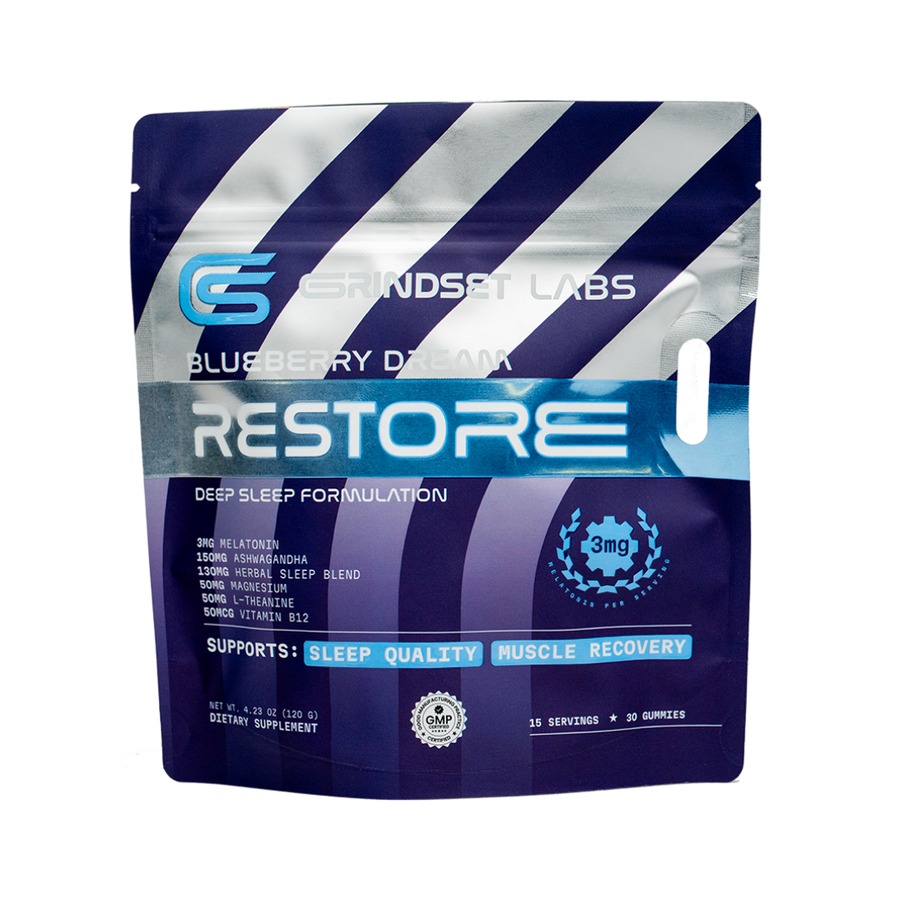
The principle of transparent, correctly-dosed ingredients is central to how Grindset Labs approaches every formula. See how this applies in practice with the Grindset Labs Restore Gummies — designed to support recovery without overcorrection.
The Problem with Relying on Melatonin Long-Term
Melatonin is one of the most studied sleep compounds available, and research generally supports its safety for short-term use. The issues arise with chronic reliance, particularly at higher doses.
Tolerance and Receptor Desensitization
Regular exogenous melatonin exposure can reduce the sensitivity of melatonin receptors over time, meaning you may require progressively higher doses to achieve the same effect. More problematically, there is some evidence that chronic high-dose melatonin supplementation may suppress endogenous production — making it harder to fall asleep naturally when the supplement is not present.
It Doesn't Address Root Causes
If you cannot fall asleep because of elevated cortisol, blue light exposure, irregular scheduling, or anxiety, melatonin does not fix any of these underlying issues. It masks the symptom without addressing the mechanism. This means the problem will persist or worsen if the supplement is discontinued without behavioral changes.
Next-Day Grogginess
Higher doses in particular are associated with significant sleep inertia — the heavy, foggy feeling upon waking that undermines the entire point of better sleep. For performance-focused individuals, trading poor sleep for groggy mornings is not an acceptable outcome.
Hormone Interaction Concerns
Melatonin interacts with multiple hormonal pathways beyond sleep regulation, including reproductive hormones. While this is not a concern for occasional use, it is worth noting for individuals using melatonin nightly at high doses over extended periods.
What "Natural Sleep Support" Actually Means
Natural sleep support refers to a category of non-hormonal compounds that support the biological conditions for quality sleep — without directly introducing exogenous hormones into the system. The goal is to work with the body's own mechanisms rather than override them.
This approach targets the same levers as melatonin — cortisol reduction, nervous system down-regulation, and sleep-stage quality — through different pathways. The advantage is that these compounds tend to support the sleep system holistically rather than delivering a single hormonal signal.
The most evidence-supported compounds in this category include magnesium, L-Theanine, ashwagandha, GABA, and 5-HTP — each working through distinct mechanisms that, in combination, address multiple aspects of sleep quality simultaneously.
Key Natural Sleep Support Compounds Backed by Research
Magnesium
Magnesium is involved in over 300 biochemical reactions in the body, including the regulation of GABA — the brain's primary inhibitory neurotransmitter. Low magnesium is directly associated with poor sleep quality, difficulty falling asleep, and more frequent nighttime waking. Magnesium glycinate is the most commonly recommended form for sleep due to its high bioavailability and low gastrointestinal side effect profile. Studies show that magnesium supplementation reduces cortisol, improves subjective sleep quality, and decreases the time to sleep onset in deficient individuals.
L-Theanine
L-Theanine is an amino acid found in green tea that promotes alpha brain wave activity — the relaxed but alert state that characterizes the transition into sleep. Unlike melatonin, it does not cause drowsiness but rather reduces anxiety-driven wakefulness, making it particularly useful for people whose sleep disruption is cognitively driven. It pairs well with other calming compounds and does not produce tolerance with regular use.
Ashwagandha (KSM-66)
Ashwagandha is an adaptogenic herb with robust evidence for cortisol modulation. Taken in the evening, it reduces cortisol's interference with melatonin production and helps regulate the HPA axis — the hormonal system responsible for the stress response. In clinical studies, ashwagandha has been shown to improve sleep onset latency, total sleep time, and sleep quality scores while simultaneously reducing anxiety markers.
5-HTP
5-Hydroxytryptophan is a precursor to serotonin, which itself converts to melatonin through the body's natural pathway. Supplementing with 5-HTP supports endogenous melatonin production without directly introducing the hormone — working upstream of the process rather than replacing it. This approach preserves the body's regulatory capacity over the amount of melatonin actually produced.
GABA
GABA supplements work by directly supporting the inhibitory neurotransmitter system responsible for quieting overactive neural activity. While oral GABA's ability to cross the blood-brain barrier is debated in the literature, research shows that GABA-containing compounds reduce stress and improve objective sleep measures, likely through enteric nervous system effects.
Understanding what is in your recovery stack is the foundation of making it work. Visit the Grindset Labs Labs page for complete ingredient transparency and third-party testing results.
Melatonin vs Natural Support: A Side-by-Side Breakdown
- Mechanism: Melatonin delivers an exogenous sleep hormone. Natural support compounds work with the body's own production and regulation systems.
- Best use case: Melatonin is most effective for circadian rhythm disruption — jet lag, shift work, travel. Natural support compounds address the broader conditions required for quality sleep regardless of timing.
- Tolerance risk: Melatonin at high doses carries receptor desensitization risk. L-Theanine, magnesium, and ashwagandha show no significant tolerance development in research.
- Morning-after effect: High-dose melatonin is associated with grogginess. Natural support compounds generally produce no next-day cognitive impairment.
- Root cause treatment: Melatonin does not address cortisol, stress load, or sleep hygiene deficits. Adaptogens and GABA-modulating compounds work on the mechanisms that prevent sleep onset.
- Flexibility: Natural support stacks can be assembled and adjusted based on individual needs. Melatonin is a single signal with limited customization of effect.
Who Melatonin Is Actually Right For
This is not an argument that melatonin is always wrong. There are specific, well-defined situations where it is the appropriate tool:
- Jet lag across multiple time zones: Melatonin at low doses (0.5 to 1 mg) taken at the target destination's bedtime is well-supported for accelerating circadian resynchronization.
- Shift workers managing irregular schedules: When the sleep window genuinely conflicts with natural light-dark cues, exogenous melatonin helps bridge the biological gap.
- Short-term sleep disruption during high-stress periods: As a temporary adjunct — not a chronic solution — melatonin can help maintain sleep quality during acute stress or travel.
The key word throughout is low dose. The common 5 to 10 milligram doses found in most retail products are pharmacological rather than physiological, and the research does not support these doses for general sleep improvement.
Your recovery approach should match your situation. For daily performance demands, explore how Grindset Labs Restore Gummies support structured overnight recovery with clean, transparent formulas.

Building a Natural Sleep-Support Stack
For most active individuals, a natural support approach will outperform melatonin as a long-term sleep strategy. Here is a practical starting framework:
- Magnesium glycinate — 200 to 400 mg taken 60 to 90 minutes before bed. This forms the base of the stack, addressing the most common micronutrient deficiency affecting sleep quality in active populations.
- L-Theanine — 100 to 200 mg taken 30 to 60 minutes before bed. Particularly valuable if anxiety or an active mind is the primary barrier to sleep onset.
- Ashwagandha (KSM-66) — 300 to 600 mg taken in the evening. Most beneficial for individuals managing high training loads or elevated occupational stress that is driving cortisol elevation.
- Consistent sleep timing — no supplement replaces the circadian anchor of going to bed and waking at the same time daily.
Start with magnesium alone if this is new territory. Assess after one week, then layer additional compounds as needed. The goal is the minimum effective intervention — not the maximum possible stack.
Conclusion — Match Your Tool to the Problem
Melatonin and natural sleep support compounds are not in direct competition — they address different aspects of the sleep problem. Melatonin is a circadian signal with a specific set of appropriate applications. Natural support compounds address the broader physiological conditions that determine whether quality sleep happens at all.
For most people dealing with difficulty falling asleep, staying asleep, or waking up unrefreshed — particularly those with high training or lifestyle demands — a natural support approach targeting cortisol, nervous system regulation, and micronutrient status will produce more consistent, sustainable results than reaching for melatonin as a first response.
The principle at Grindset Labs is consistent: clean ingredients, transparent dosing, and formulas built around what the body actually needs. That same principle applies to sleep. Give your system what it needs to do the work naturally — and let recovery compound over time.
Ready to build a complete performance and recovery system? Start with the Grindset Labs 7-Day Trial Packs and experience the difference a structured, science-backed approach makes within the first week.

FAQs
Is melatonin safe to take every night?
Short-term use at low doses — 0.5 to 1 milligram — is generally considered safe based on current research. Nightly use at high doses (5 to 10 mg) over extended periods carries more uncertainty, particularly around receptor sensitivity and hormonal interaction. Natural support compounds are generally better suited for nightly, long-term use.
What is the best natural alternative to melatonin?
Magnesium glycinate is the strongest single-compound recommendation for most people as a melatonin alternative. It addresses one of the most common physiological deficits affecting sleep quality in active individuals and has a well-established safety profile at therapeutic doses. L-Theanine is the best addition for those whose primary barrier is an anxious or active mind.
Can I take melatonin and natural sleep support together?
Yes, in appropriate situations — for example, using low-dose melatonin for jet lag while maintaining a magnesium and L-Theanine routine. The key is using melatonin for its specific, short-term applications rather than as a nightly crutch alongside other compounds.
How long before bed should I take natural sleep support supplements?
Magnesium and ashwagandha are best taken 60 to 90 minutes before your intended sleep time. L-Theanine can be taken 30 to 60 minutes before. Consistency in timing relative to your sleep schedule matters more than hitting an exact clock time.
Will natural sleep supplements make me groggy in the morning?
At appropriate doses, no. Unlike high-dose melatonin, natural sleep support compounds — magnesium, L-Theanine, ashwagandha — do not carry a significant morning-after grogginess effect and generally produce no next-day cognitive impairment in research settings.